The Resurrection of Jesus: What Happens When You Actually Trace the Evidence
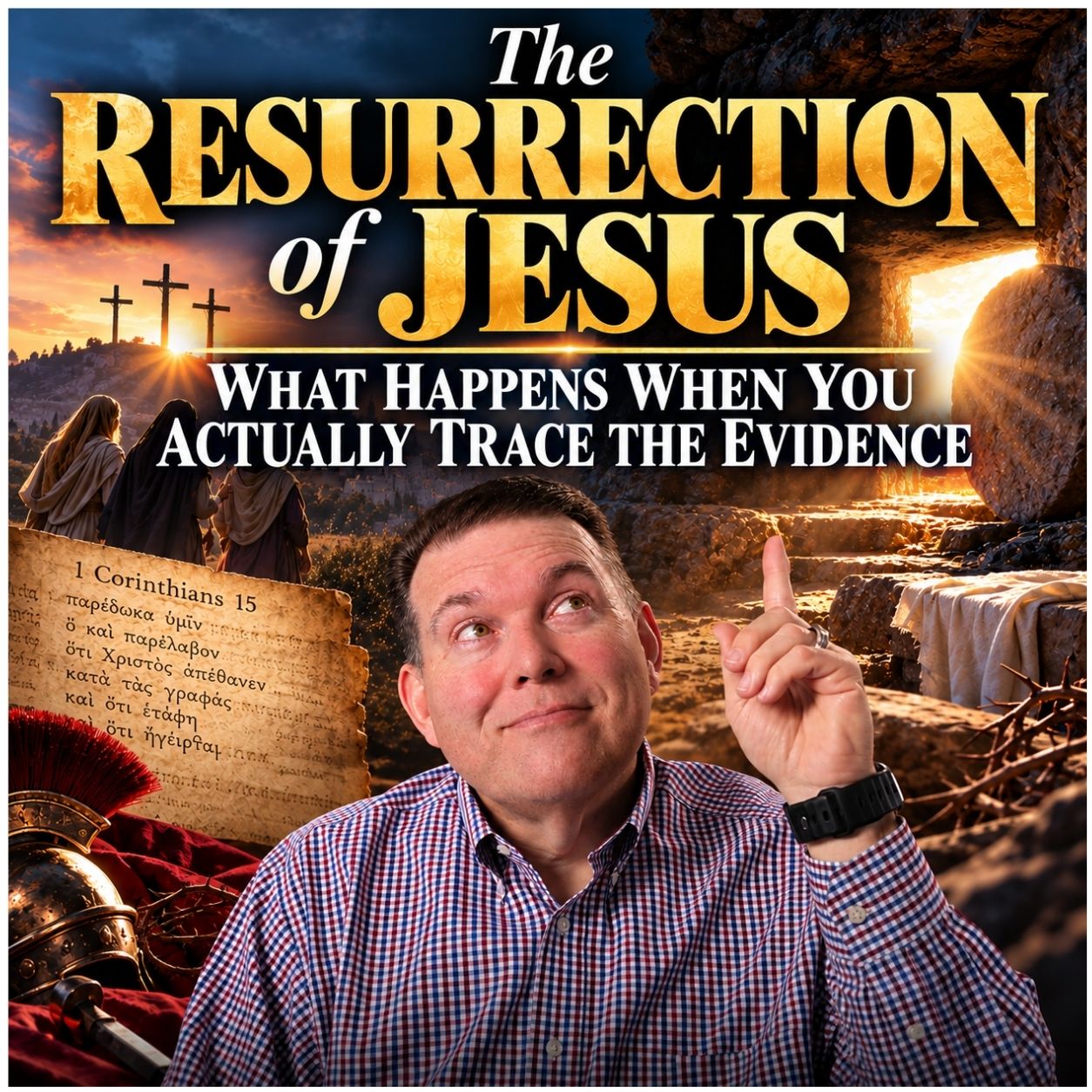
Four lines of historical evidence point toward the same conclusion: something happened outside a tomb in Jerusalem roughly two thousand years ago that even the earliest skeptics couldn't explain away. The resurrection creed dates to within a few years of the crucifixion. Every gospel names women as the first witnesses, at a time when a woman's testimony carried no legal weight. The tomb's emptiness is accepted by most scholars who study the period, including many who reject the resurrection itself. And the people closest to the story kept saying it happened even after it cost them everything. None of that is mathematical proof. It's a lot more than sentiment, though.
I'm Ralph Estep Jr., a licensed public accountant with more than 30 years in the business, and in my work I test whether a number someone hands me actually holds up before I believe it.
Quick Take
-
The resurrection creed in 1 Corinthians 15 dates to within a few years of the crucifixion, not decades later
-
Every gospel account names women as the first witnesses, a detail nobody inventing a story in that culture would choose
-
Most scholars who study the period, including ones who reject the resurrection, accept that the tomb was found empty
-
Several of the earliest disciples died rather than take back what they claimed to have seen
-
The leading alternative theories (swoon, wrong tomb, hallucination, legend) each explain a piece of the evidence, but not all of it
Why does it matter that the resurrection creed is so early?
Paul opens 1 Corinthians 15 by saying he delivered what he had received. Those were technical terms for handing down a fixed oral tradition. Most scholars, believers and skeptics alike, date that formula to within a handful of years of the crucifixion. Legends usually need decades to grow. This one shows up while the people who could have contradicted it were still walking around Jerusalem.
Why did the gospels put women at the tomb first?
The first century historian Josephus described the legal standard of the time this way, that a woman's testimony shouldn't be admitted in court because of what he called the levity of her sex. That's the world the gospel writers lived in. If you were fabricating a resurrection story to sell it, you don't hand your credibility to witnesses nobody in your culture would trust in court. Every single gospel does exactly that anyway.
Was the tomb of Jesus actually empty?
Jerusalem is the worst possible city to lie about an empty tomb in. It's where Jesus was crucified, where his body would have been, and where anyone could walk over and check. Rome and the temple leadership both had the motive, the power, and the simplest possible tool to kill the movement: produce the body. Neither one ever did. An empty tomb doesn't prove a resurrection on its own. It does mean the debate was never really about whether the tomb was empty. It was about why.
Why did the disciples keep saying this after they had every reason to stop?
People die for things they sincerely believe are true all the time. It's much rarer for people to die for something they personally invented. The first disciples were the source of the claim, not people who inherited it secondhand. Several of them were beaten, jailed, run out of cities, and some were killed for refusing to take it back, and every one of them had an easy exit the whole time. None of them took it.
What about the theories that Jesus never really died, that people hallucinated, or that the story just grew over time?
The swoon theory says Jesus survived the cross and revived in the cool of the tomb. Roman execution wasn't amateur work, and the historian Tacitus, no friend of early Christianity, records that Jesus suffered the death penalty under Pontius Pilate. A half-dead man crawling out of a tomb needing medical help doesn't inspire a movement. The wrong tomb theory falls apart just as fast, since Joseph of Arimathea knew exactly which tomb was his.
Hallucination deserves a more serious look. Grief does strange things to people. The problem is that hallucinations are private experiences, and they tend to confirm what the grieving person already expects. Five hundred people sharing the same experience at once doesn't fit that pattern, and a hallucination still doesn't explain a missing body.
Legend is the strongest of the four, and it's worth taking seriously because stories genuinely do grow over time. Here's where it strains: the bodily resurrection sits in the earliest layer of the tradition, not somewhere it grew into later. Paul names living witnesses people could go check. That's not how legends usually work. They tend to get vaguer, not more specific, the further you trace them back.
FAQ
Is there actual historical evidence for the resurrection, or is it only a matter of faith?
There's real historical material to weigh, including an early creed, named witnesses, and an empty tomb accepted across the scholarly spectrum. It isn't mathematical proof, but it's a case that can be examined rather than only felt.
What is the swoon theory, and why do most scholars reject it?
It claims Jesus never actually died on the cross and revived later in the tomb. Most scholars reject it because Roman crucifixion was designed to guarantee death, and ancient sources outside the Bible confirm the execution happened.
Do historians agree that Jesus existed and was crucified?
Yes. That much is close to a historical consensus, including among scholars who don't accept the resurrection. The debate is over what happened next.
What should I say if my kid asks how I know Jesus rose from the dead?
Tell the truth if you don't have an answer yet. Something like, "That's a really good question, let me look into it," does more for a kid's faith long term than getting defensive ever will.
If this raised a question you've been carrying for a while, listen to the full episode of Truth Unveiled with Ralph, Episode 66, "Did It Actually Happen?" And if you're ready to respond to what you heard, go to truthunveiledwithralph.com/decision.

Ralph V. Estep, Jr. is a Delaware-based licensed accountant, author, rancher, and media host with more than 30 years of experience in finance, taxation, and small-business leadership. As the founder of Saggio Accounting+PLUS and the creator of the Ask Ralph Media network, Ralph helps entrepreneurs, creators, and everyday families replace money confusion with clarity, confidence, and practical next steps—without shame and without hype.
Ralph’s work blends deep professional expertise with a coach’s mindset and a communicator’s heart. He has held leadership roles across public accounting, financial institutions, law firms, and technology organizations, bringing a rare combination of traditional accounting rigor and modern systems thinking to the people he serves. A graduate of the University of Delaware and Wilmington University (MBA), Ralph is known for turning complex money topics into simple, repeatable frameworks that help people make wiser decisions and build lasting financial stability.
Through Ask Ralph Media, Ralph hosts multiple shows designed to meet people where they are and guide them forward. He is the host of Financially Confident Christian, a daily, faith-based show offering warm, pastoral encouragement for listeners who want peace and practical wisdom with their finances.
He also hosts Truth Unveiled with Ralph, a weekly program that contrasts cultural pressure with biblical truth and invites listeners into deeper spiritual and practical alignment. For small business owners, Ralph leads Grit and Growth Business, spotlighting real sto… Read More

The Psalm God Never Fixed (And What It Means for Your Prayers)