Money Fights in Marriage: What the Bible Actually Says (And How to Stop)

Money Fights in Marriage: What the Bible Actually Says (And How to Stop)
Let me paint you a picture, and you tell me if you've lived it.
It's a Tuesday night. The kids are finally down. You're both exhausted. And one of you says the sentence: "You spent what?"
Just like that, you're not on the couch anymore. You're in a courtroom. One prosecutor, one defendant, and evidence going back years. The thing they bought without asking. The time you said "we can't afford it" and then did the exact same thing yourself. You're not talking about money anymore. You're keeping score. And you go to bed back to back, same bed, same blanket, two feet apart, feeling like you're on opposite sides of a war.
I got a message not long ago that I could have gotten from a thousand people, because it's that common: my spouse and I fight about money constantly. What does the Bible say?
So let me tell you first what the Bible doesn't say. It doesn't say you're broken. It doesn't say you're a bad Christian. Money is one of the most common things married couples fight about, and if that's your house, you're in enormous company.
Here's the thing I most want you to hear, and it's really the whole message: the fight was never you against your spouse. It was always the two of you against the problem. And God has a lot to say about which team you're actually on.
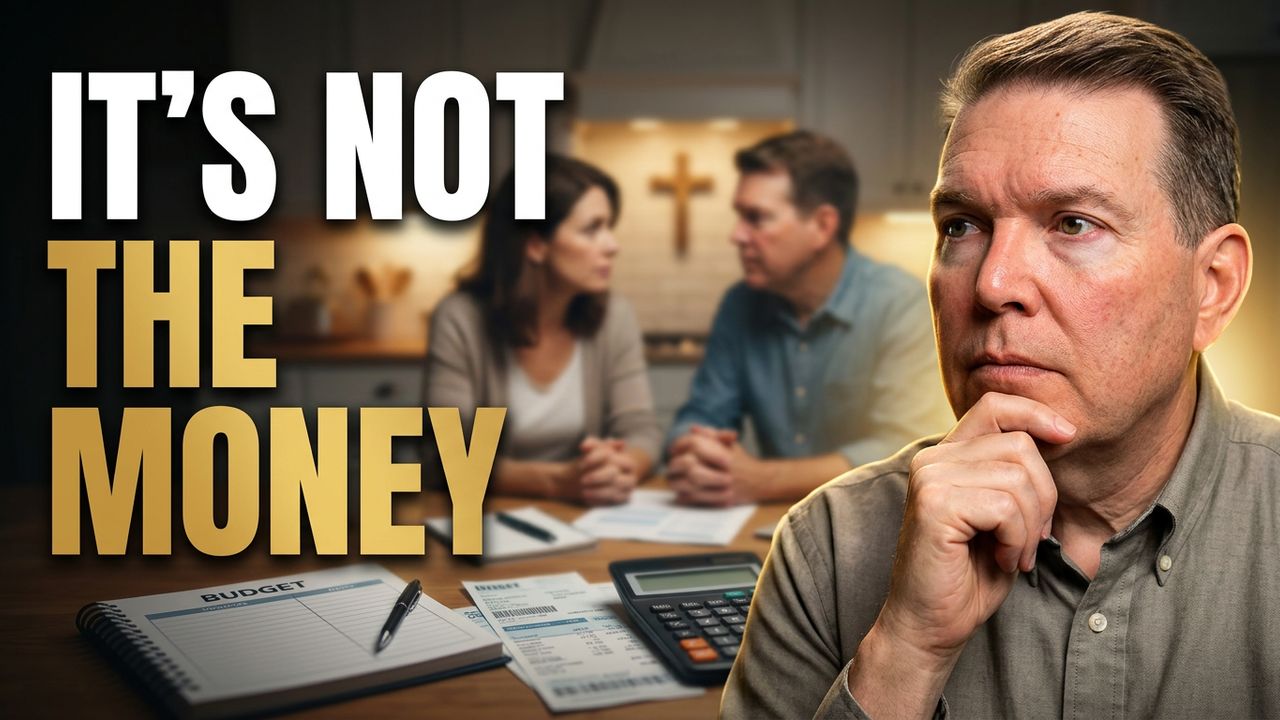
The Fight Is Almost Never About the Money
Thirty years across a desk from couples taught me this. Now, that sounds crazy, since there's a real number on a real statement, so in one sense it obviously is about the money. Stay with me for a second, though.
Couples don't fight about the dollars. They fight about what the dollars mean.
What "You Spent What?" Really Means
"We can't afford that" doesn't land as a budget fact. It lands as I'm failing. I can't provide. I'm not enough.
Secret spending usually isn't about the item at all. It's about wanting one thing in the world that nobody else gets to control. And the nickel-saver who acts like the sky is falling over a dinner out? Somewhere back there, the sky actually did fall, and they swore they'd never be caught off guard again.
The Money Story You Didn't Know You Were Writing
You didn't marry a spreadsheet. You married a person who came to you with a whole history you didn't write.
We all grew up absorbing money lessons we didn't know we were learning:
● Some of us watched our parents fight about it and swore we'd do it differently.
● Some watched our parents never talk about it, so silence feels safe now.
● Some grew up with nothing, so money feels like fear.
● Some grew up with plenty, so money feels like freedom.
Then two completely different money stories stand at an altar, say "I do," and start running one bank account. The friction isn't proof that something's wrong with your marriage. It's that nobody ever explained; you each showed up with a different script.
Listen to how James puts it: Where do wars and fightings among you come from? Don't they come from your pleasures that war in your members? (James 4:1). Read that slowly. The war is within you. It doesn't start with your spouse; it starts with something already at war inside your own heart, whether that's fear, pride, control, or an old wound. Your spouse didn't start the war. Most of the time, they just walked into one that was already running.
This is why more budgeting tips won't fix it. You could have the best spreadsheet in Delaware and still end up back to back. The problem is deeper than math, so the answer has to be deeper too.
What the Bible Actually Says: You're Not Two
Here's the turn. You've been living like two people with one problem stuck between you: two accounts, two opinions, two sides. God looked at marriage and said something wild: you're not two.
So they are no longer two, but one flesh (Mark 10:8).
You're One Body, Not Two Hands Fighting Over a Wallet
That's not a wedding sentiment to cross-stitch on a pillow. It's a design statement. It's what you actually are.
Your other hand doesn't get a splinter and say, "well, that's your problem." One part hurts and the whole body responds, because it's one body. Too many of us are treating marriage like two hands fighting over a wallet, when God says it's one body, and part of it is quietly drowning while the rest keeps score.
When your spouse is going under in financial fear, that's not your opponent going under. That's you going under. You just haven't felt it yet.
Your Bank Account Is a Heart Map
Jesus says something I'd want tattooed on every marriage: where your treasure is, there your heart will be also (Matthew 6:21).
Notice the order. Your heart follows your treasure, not the other way around. So your bank account isn't just math; it's a heart map. Show me where the money goes and I'll show you what the heart has quietly been worshiping. A money fight, underneath, is just two hearts chasing two different treasures, surprised they keep ending up in two different places.
And here's the grace in all of this: God isn't standing outside your money life with His arms crossed, grading you. He wants in. Not just Sunday morning, but the checking account, the fear, the Tuesday night at the kitchen table.
Ecclesiastes tells us what happens when you stop trying to do it alone: two are better than one, for if they fall, the one will lift up his fellow, and a threefold cord is not quickly broken (Ecclesiastes 4:9-12). Three strands: you, your spouse, and God woven right down the middle. Two strands come apart under strain, and you've felt that. Weave God through your marriage and your money as the third strand, and the whole thing holds.
That's the team. That was always the team.
Five Ways to Get Back on the Same Team
I don't want to send you home with a nice feeling and no plan, because this ministry doesn't just inform, it equips. Here's the practical path, the same thing I'd walk a couple through in my office.
- Call a truce and name the real enemy. Before you touch a single number, agree out loud that the enemy is not the person across the table. It's the problem on the table: the debt, the fear, the pattern. Problem on one side, both of you on the other.
- Tell each other your money story. Not the fight, the story. Ask the same question of each other: what did money feel like in the house you grew up in? Once you understand why your spouse grips money the way they do, you stop seeing an opponent and start seeing a kid who learned something a long time ago. That's where compassion comes back into the room.
- Get a regular money date. Not an ambush, not "we need to talk" dropped in the middle of a brutal week. A set time, low pressure, a cup of coffee, looking at the numbers together on purpose. Scheduled feels safe; sprung on us feels like a fight.
- Give every dollar a job you both agreed to. This is the heart of it. A budget isn't a leash one of you holds; it's a plan you both signed. When every dollar already has a job you decided together, there's nothing left to fight over, because you had the conversation before the money got spent. It moves the argument out of the kitchen at 9 pm and onto the table on money-date day, where you can actually think.
- Set your rules of engagement. Every couple needs a few, and God gives one of the best: be angry, and don't sin; don't let the sun go down on your wrath (Ephesians 4:26). You're allowed to be frustrated. You are not allowed to go to bed as enemies. You can disagree about a number and still reach across the mattress and say, "We're on the same team. We'll figure it out tomorrow."
You Were Always on the Same Team
That right there is the whole thing: two people who decided the marriage matters more than being right about the money.
I've never once seen somebody truly win the money fight. I've only seen people win it and lose the person.
You're on the same team. You always were.

Ralph V. Estep, Jr. is a Delaware-based licensed accountant, author, rancher, and media host with more than 30 years of experience in finance, taxation, and small-business leadership. As the founder of Saggio Accounting+PLUS and the creator of the Ask Ralph Media network, Ralph helps entrepreneurs, creators, and everyday families replace money confusion with clarity, confidence, and practical next steps—without shame and without hype.
Ralph’s work blends deep professional expertise with a coach’s mindset and a communicator’s heart. He has held leadership roles across public accounting, financial institutions, law firms, and technology organizations, bringing a rare combination of traditional accounting rigor and modern systems thinking to the people he serves. A graduate of the University of Delaware and Wilmington University (MBA), Ralph is known for turning complex money topics into simple, repeatable frameworks that help people make wiser decisions and build lasting financial stability.
Through Ask Ralph Media, Ralph hosts multiple shows designed to meet people where they are and guide them forward. He is the host of Financially Confident Christian, a daily, faith-based show offering warm, pastoral encouragement for listeners who want peace and practical wisdom with their finances.
He also hosts Truth Unveiled with Ralph, a weekly program that contrasts cultural pressure with biblical truth and invites listeners into deeper spiritual and practical alignment. For small business owners, Ralph leads Grit and Growth Business, spotlighting real sto… Read More

Why Does God Ask Questions When He Already Knows the Answer?