Living Authentically in a World of Expectations
Living Authentically in a World of Expectations
You're scrolling through social media, and you see a post from someone at your church. Perfect family. Perfect house. Perfect faith journey. You click away and think, "That's not real."
Then you look at your own life and realize you're doing the same thing.
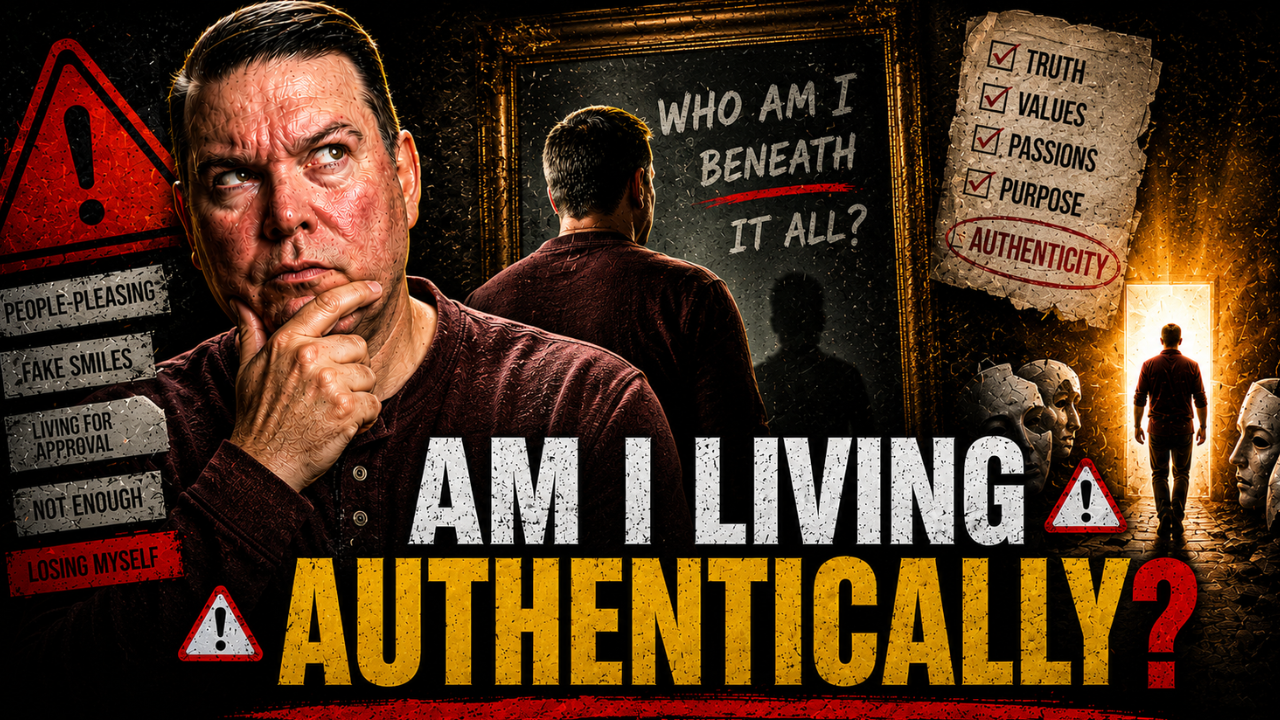
We all have a version of ourselves we show the world. Maybe it's the polished professional at work. Maybe it's the "I've got it together" Christian at church. Maybe it's the strong one in your family who can't ever ask for help. We build these personas carefully, layer by layer, until we're not even sure who we are underneath.
But here's what I've learned: that exhaustion you feel? That's what it costs to live as a character instead of a person.
This is the real conversation I want to have with you today.
The Gap Between Performance and Reality
There's a moment in Genesis 3 that haunts me. Adam and Eve have just eaten the fruit. They've hidden themselves among the trees. And God asks them, "Where are you?"
On the surface, it's a strange question. God knew exactly where they were physically. But He was asking something deeper: Where is your heart? Who are you now that you've hidden?
That question still echoes.
We perform for different reasons. Some of us learned early that our real selves weren't safe, so we built masks to survive. Others started small—just one lie to avoid disappointing someone—and then kept adding layers because backing up felt harder than pushing forward.
You say yes to commitments you resent. You downplay struggles you're drowning in. You laugh at jokes that make you uncomfortable. You nod along with opinions that contradict what you actually believe.
And nobody knows.
The person who knows you best at church doesn't know you. Your closest friend doesn't know you. Sometimes you're not even sure you know you anymore.
But God does. He's asking: "Where are you really?"
What Authenticity Isn't
Before we go further, let me be clear about something.
Biblical authenticity is not a license to do whatever you want. It's not "I'm just being true to myself" as an excuse to abandon your commitments or hurt people. That's just selfishness wearing better clothes.
And it's not the Instagram version of authenticity—the carefully curated "raw and real" post that's actually just a different kind of performance. It's not the vulnerability that's designed to get likes.
Real authenticity is uncomfortable. It doesn't come with good lighting.
What Authentic Living Actually Looks Like
Here's what I mean by biblical authenticity: you acknowledge that God created you, Christ redeemed you, and the Holy Spirit is actively transforming you. You're not the final authority on who you are. God is.
This changes everything.
It means you stop trying to perfect yourself and start inviting God to change you. It means bringing the real you—the scared version, the doubting version, the version with contradictions and inconsistencies—before God and saying, "Search me. Show me the truth about myself, even the parts I don't want to see."
And then actually listening.
Authenticity isn't something you achieve. It's something you practice. It's a daily choice to align your actions with what you actually believe instead of with what you think people want from you.
Why Performance Is So Expensive
Performance is exhausting because it's never finished.
You wake up and assemble yourself. What version do you need today? The competent version for the office. The faithful version for your small group. The strong version for your family. The relaxed version for your friends. By the time you're alone, there's nothing left.
Many of us have chosen performance because authenticity feels dangerous. What if people don't like the real version? What if the real version isn't good enough?
Scripture speaks directly to this fear. In Proverbs, we're warned: "The fear of man lays a snare." When you live for other people's approval, you're trapped. You're constantly managing their opinions, their moods, their judgments. You're not free.
And in Romans 12:2, Paul writes, "Do not conform to this world, but be transformed by the renewing of your mind." He's not just giving advice. He's naming what happens when you let people's expectations shape you instead of God's truth.
You stop growing. You stop becoming who you were actually created to be.
How to Know If You're Living Inauthentically
Stop and ask yourself these questions:
Do you feel spiritually exhausted? Not just tired. Do you wake up drained in a way that sleep doesn't fix? That's what performance does.
Are you more concerned with how things look than whether they're true? You'd rather people think you're fine than actually be honest about struggling.
Do you have secrets you're keeping from everyone? Not just one person, but a whole compartment of your life that nobody knows about?
Do you believe different things depending on who you're talking to? You shift your positions, your opinions, maybe even your values to match whoever's in the room.
These aren't character flaws. They're signals. They're invitations to change.
The Real Cost of People-Pleasing
You can't serve two masters. When your approval comes from people, you're constantly bending. You apologize for things you shouldn't. You minimize your own needs. You agree with things you disagree with.
And here's the thing nobody wants to admit: when you start living authentically, some people will be upset.
Not because you're doing anything wrong. But because you're no longer available to play the role they assigned you. The person who needed you to be the strong one is upset that you're admitting you struggle. The friend who liked having someone to fix is frustrated that you're setting boundaries. The family member who benefited from your people-pleasing is confused about why you're saying no.
That discomfort is theirs to work through. Not yours to fix.
Steps Toward Authentic Living
Start with honesty. Tell God—actually say it, not just think it—"I'm scared. I'm hiding. I don't know who I really am anymore." Honesty breaks the spell that keeps us performing.
Pick one area. Not everything at once. That's overwhelming, and it won't stick. Choose one relationship, one belief you're faking, one commitment you resent. Start there.
Let Scripture reshape how you see yourself. Read not for self-help tips, but to let God confront the lies you believe about yourself. You're not what your parents told you. You're not what your worst failure defined you as. You're not what the person who hurt you said you were. Scripture tells you a different story about who you are.
Take small steps. Share one real thing with one trusted person. Set a boundary. Say no when you mean no. Admit you were wrong. These feel vulnerable because they are. But they're also how you rebuild trust in yourself.
Steps Toward Authentic Living
Start with honesty. Tell God—actually say it, not just think it—"I'm scared. I'm hiding. I don't know who I really am anymore." Honesty breaks the spell that keeps us performing.
Pick one area. Not everything at once. That's overwhelming, and it won't stick. Choose one relationship, one belief you're faking, one commitment you resent. Start there.
Let Scripture reshape how you see yourself. Read not for self-help tips, but to let God confront the lies you believe about yourself. You're not what your parents told you. You're not what your worst failure defined you as. You're not what the person who hurt you said you were. Scripture tells you a different story about who you are.
Take small steps. Share one real thing with one trusted person. Set a boundary. Say no when you mean no. Admit you were wrong. These feel vulnerable because they are. But they're also how you rebuild trust in yourself.
What Changes When You Stop Performing
You'll lose some relationships. The ones built on a false version of you aren't relationships—they're transactions.
You'll feel relief in a way that's hard to describe until you experience it. There's a lightness that comes from not carrying a character anymore.
You'll have more energy. Performance is costly. When you stop, that energy goes back into actually living.
And you'll find something else: permission. When you live authentically, other people get permission to be authentic too. Your honesty gives them space to be honest. Your vulnerability invites their vulnerability.
The Difference Between Living for God's Approval and People's Approval
God already knows who you are. He made you. He doesn't need you to be someone else. He doesn't need you to perform.
What God invites you to is transformation. Not a performance-based change that makes you look good. Real, internal change that makes you become who you were actually created to be.
He can see the real you. And the real you is who He loves.
The Real Question
This week, I want you to sit with something. Not answer it immediately, but let it sit with you.
Who am I pretending to be?
Then follow that question: What would change if I stopped? What am I actually afraid will happen if I'm real?
And then one more: What would change if I lived as though God's approval was enough?
The discomfort you feel when you ask these questions—that's not a sign you should stop asking. That's where growth happens.
The Invitation
Living authentically isn't selfish. It's the only honest way to love God and the people around you. You can't give your real self to anyone—and I mean really give it, not just perform it—if you haven't found your real self first.
The masks you're wearing? They were useful once. They helped you survive. But they're not helping you anymore. They're just keeping you stuck.
God is inviting you to something better. Not perfection. Not the Instagram version of authenticity. Just you. Real, flawed, uncertain you.
That's enough.
Where are you, really?
That's the question God's asking. And the answer you give matters more than you know.

Ralph V. Estep, Jr. is a Delaware-based licensed accountant, author, rancher, and media host with more than 30 years of experience in finance, taxation, and small-business leadership. As the founder of Saggio Accounting+PLUS and the creator of the Ask Ralph Media network, Ralph helps entrepreneurs, creators, and everyday families replace money confusion with clarity, confidence, and practical next steps—without shame and without hype.
Ralph’s work blends deep professional expertise with a coach’s mindset and a communicator’s heart. He has held leadership roles across public accounting, financial institutions, law firms, and technology organizations, bringing a rare combination of traditional accounting rigor and modern systems thinking to the people he serves. A graduate of the University of Delaware and Wilmington University (MBA), Ralph is known for turning complex money topics into simple, repeatable frameworks that help people make wiser decisions and build lasting financial stability.
Through Ask Ralph Media, Ralph hosts multiple shows designed to meet people where they are and guide them forward. He is the host of Financially Confident Christian, a daily, faith-based show offering warm, pastoral encouragement for listeners who want peace and practical wisdom with their finances.
He also hosts Truth Unveiled with Ralph, a weekly program that contrasts cultural pressure with biblical truth and invites listeners into deeper spiritual and practical alignment. For small business owners, Ralph leads Grit and Growth Business, spotlighting real sto… Read More

Working Hard but Never Getting Ahead? What the Bible Says About a Bag With Holes